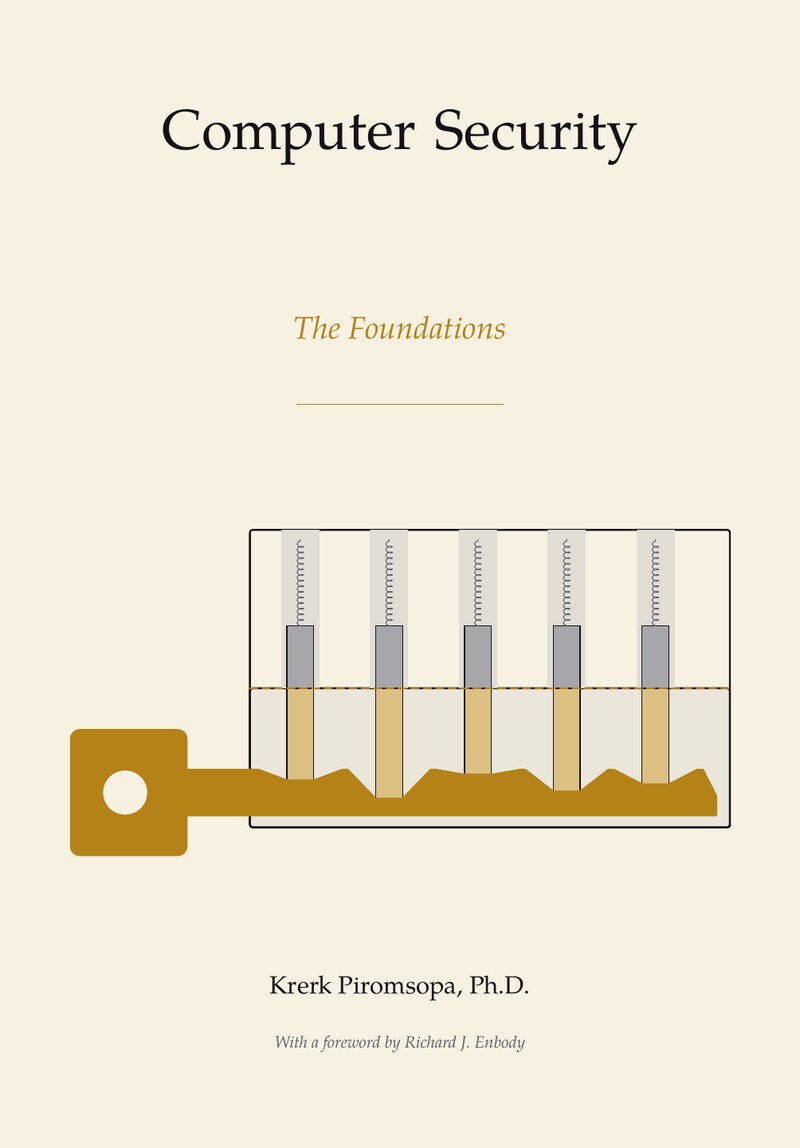
About This Book
For decades, computer security has played a critical role in the connected world. The widespread adoption of the internet, smartphones, and cloud services has raised the stakes dramatically: today the average person carries two or three networked computers at all times, and the consequences of a compromise—financial loss, identity theft, disruption of critical infrastructure—affect everyone, not just specialists.
Written for computer science and computer engineering students, this textbook is also readable by anyone who wishes to understand why security matters and how it works. It grew from two decades of teaching computer security at Chulalongkorn University.
The book is divided into three parts. Part I lays the conceptual groundwork: the CIA triad, the AAA framework, privacy, risk management, and social engineering. Part II equips the reader with the principal technical disciplines used to build and analyse secure systems: Cryptography, Software Security, Network Security, Digital Forensics, and AI & Machine Learning Security. Part III examines recurring vulnerability classes: Buffer Overflow, Input Validation and Injection Attacks, Physical Security, Malware, and Cloud Security.
Every chapter includes Learning Objectives, worked examples, exercises, and an annotated Further Reading list. A Glossary of key terms and an Index appear at the end of the book.
Recommended course focus
Table of Contents
- Ch 1 Introduction to Computer Security
- Ch 2 Authentication
- Ch 3 Authorization
- Ch 4 Auditing
- Ch 5 Integrity
- Ch 6 Cryptography
- Ch 7 Software Security
- Ch 8 Network Security
- Ch 9 Digital Forensics
- Ch 10 AI and Machine Learning Security
- Ch 11 Buffer Overflow
- Ch 12 Input Validation and Injection Attacks
- Ch 13 Physical Security
- Ch 14 Malware
- Ch 15 Cloud Security
- A 2 Hacking Password
- A 6 Fundamental of Cryptography
- A 6b Public Key Infrastructure
- A 7 Secure Software / Simple Web Server
- A 8 Network Scanner with NMAP
- A 9 Digital Forensics
- A 11 Buffer Overflow
- A 13 Physical Security
Activity numbers correspond to their chapter (e.g., Activity 9 supplements Chapter 9).
Class Activities
Hands-on activities accompany several chapters. The exercises below require downloadable files; all other activities use tools installed via the system package manager or freely available online.
Hacking Password
Brute-force and rainbow-table attacks on SHA-1 hashed passwords using a common-credential dictionary.
Fundamental of Cryptography
Statistical analysis of Caesar cipher, Vigenère encryption, ECB/CBC block cipher modes, and digital signatures with OpenSSL.
Public Key Infrastructure
Inspect TLS certificate chains with OpenSSL, explore root and intermediate CAs, and implement certificate validation in Python.
Secure Software / Simple Web Server
Progressively harden a minimalist Python HTTP server against DoS, information disclosure, and tampering attacks.
Network Scanner with NMAP
Host discovery, port scanning (SYN/TCP/UDP), service & version detection, OS fingerprinting, NSE scripts, and output formats.
Digital Forensics
Extract GPS location from EXIF metadata; recover a deleted file from a disk image using TestDisk.

Buffer Overflow
Stack layout analysis, stack smashing to redirect execution, and exploiting a buffer-overflow challenge binary with a Python script.
Physical Security
JavaScript injection via an unattended browser session; reverse-shell trapdoor using Netcat.
Downloads
The complete book, as a PDF Free download
The full text of Computer Security: The Foundations is published here as a free PDF, ISBN 978-616-637-558-9. This page is the official distribution point named on the book’s copyright page. A paperback edition, ISBN 978-616-637-567-1, will be printed in Bangkok by Chulalongkorn University Press, and is open for pre-order within Thailand.
The author grants permission for that PDF to be downloaded, stored, and printed for personal study, and to be reproduced without charge for non-commercial classroom instruction — provided the work is reproduced in full, that the copyright page is included, and that no fee is charged beyond the direct cost of reproduction. All other rights, including commercial reproduction, translation, and derivative works, remain reserved.
Download the book (PDF, 22 MB)
If the button does not work, use the direct link.
Activity files
All activity files are hosted here. Download them with your browser or with curl:
To download from the command line:
curl -O https://www.cp.eng.chula.ac.th/~krerk/books/ComputerSecurity/files/simple_web_server.py
curl -O https://www.cp.eng.chula.ac.th/~krerk/books/ComputerSecurity/files/exif-sample.jpg
curl -O https://www.cp.eng.chula.ac.th/~krerk/books/ComputerSecurity/files/disk-sample.zip
curl -O https://www.cp.eng.chula.ac.th/~krerk/books/ComputerSecurity/files/victim-2020
chmod +x victim-2020   # make the binary executable
Student supplements Available
Free study aids that accompany the book. Reproduce and adapt them for non-commercial classroom use, with attribution.
All four are bundled in one archive:
student-package.zip
— or download items individually once posted.
Pre-order the Paperback
Printing in Bangkok Thailand only
The paperback, ISBN 978-616-637-567-1, will be printed by Chulalongkorn University Press — 434 pages, four-colour cover, perfect bound. Pre-ordering it costs 400 baht a copy, delivery within Thailand included, which is about half what a single print-on-demand copy costs from abroad. The PDF above stays free either way.
Every pre-order also comes with the Keycards: a set of four double-sided cards the size of a credit card, one topic each — choosing cryptography, network scanning, digital forensics and injection attacks. Each card hides one enciphered word; break all four and they spell out the sentence behind Zero Trust.
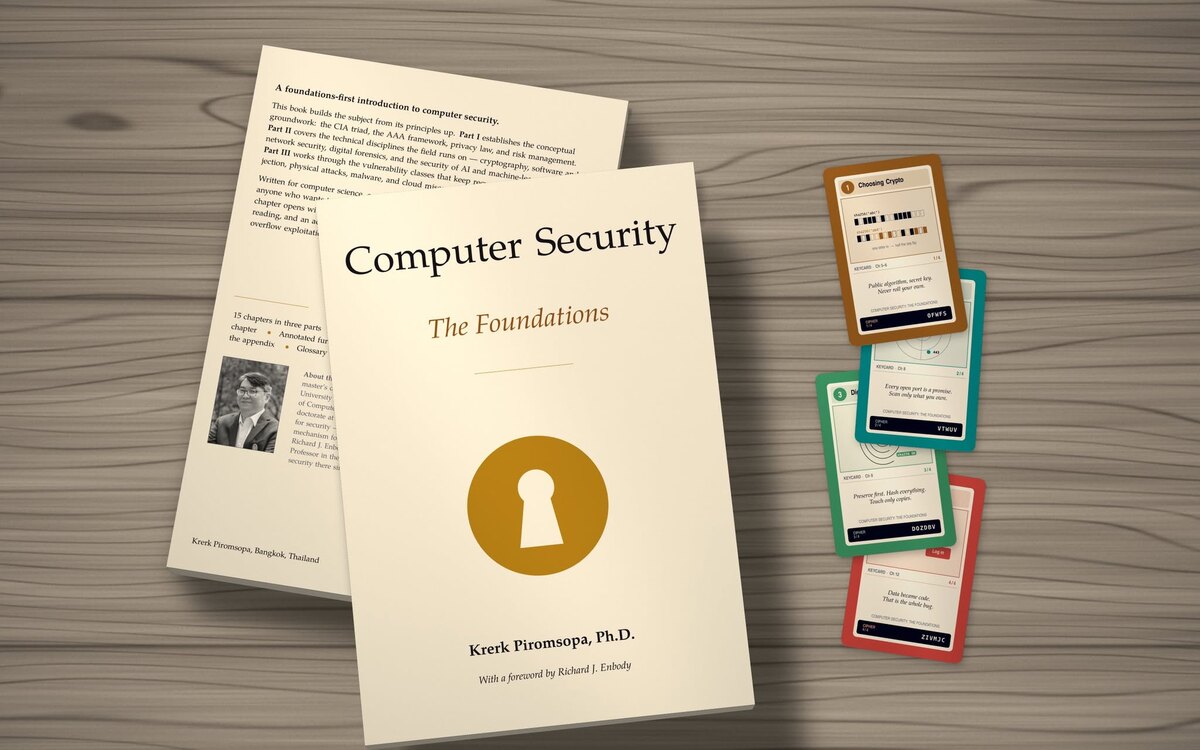 A mockup of the cover and card artwork — the run has not been
printed yet.
A mockup of the cover and card artwork — the run has not been
printed yet.
Delivery is within Thailand only — elsewhere, the PDF is free, and a print-on-demand edition is planned.
Pre-order the paperback (400 THB)
สั่งจองฉบับพิมพ์ล่วงหน้า เล่มละ 400 บาท รวมค่าจัดส่งในประเทศไทย พร้อม Keycard ครบชุด 4 ใบ — รายละเอียดและแบบฟอร์มสั่งจองเป็นภาษาไทย อยู่ที่ปุ่มด้านบนครับ
For Instructors
Instructor package By request
Adopting this book for a course? An instructor package is available on request. It includes:
- Lecture slide decks — one per chapter, as PDF and editable LaTeX source
- Course maps and a sample syllabus — 15-week and 10-week schedules, prerequisite graph, assessment split
- Lab setup guide — how to make each activity run, including the buffer-overflow toolchain and a legal scan target
Slides may be adapted and presented for non-commercial classroom instruction, with attribution. Exercise solutions and the test bank are supplied only to instructors who ask for them, and are not for redistribution. Full terms travel with the package.
Request the instructor package
Use your institutional email address. The download link appears as soon as you submit the form, and a copy is emailed to you; requests from other domains are passed to the author for approval. If the form does not work, write instead.
See where the book is being adopted, and choose whether your course is listed.
About the Author