Creative Hardware Laboratory
CREATE
Motto: We don't solve problems. We create solutions !
This is a small research group targeting undergraduate and master
students. Our group mainly focusses on "making" small and
embedded systems for fun (and occassionally publish). The spectrum of
our interest covers three levels:
1) ground zero -- we aim to build a
small computer from ground up using
FPGA technology.
2) platform one -- we use the existing embedded system such as "Linux
computer" (for example Gumstix products) to make some interesting and
useful devices, such as a backup system via Wifi.
3) Sky is the limit -- we are looking out for novel hardware
approach to solve computational problems.
Currently, we have three faculty members joining the lab:
We have a few student members:
Peera -- Ph.D. student doing dynamic
reconfiguration for a living.
<insert Krek's students here> -- the Gumstix group
We encourage any undergraduate student who is interested in "making"
things to contact our members to join the lab.
Interview with the
lost-mind
CREATE:
Why
this lab?
PC: I love
hardware. It is more perfect than software and it is cool!
You can touch and play with "devices". Software is all virtual.
It is for sissy!
KP: Making a sort of
"set-top" box can be a lot of fun. Hardware is another dimension
in computer engineering. In fact, it should be the major faction.
I think our undergrad. students show that they can "make" things.
Just go to see students who are trying to complete their Tretis
machines (a part of the course "hardware synthesis lab"), they are
enjoying themselves. So, this lab will be their meeting place.
NN: Many students want to
"own" a company. Doing software service is one way.
However, we do have a plan to conquer the world, by creating our own
technology and sell it for money. I am a strong believer that
"making" things is the only way to go for "megaclever" engineering
students.
Peera: Eh,.. my advisor
asked me to join this fun club (oops, no, the lab). I like
hardware. I think it is fun and easy to make an interesting
working prototype. I did make a number of CPUs myself. They are
really funny.
History (How can a
new lab has a history?)
Well whatever you think, here is some example of our work:
<fig 1 Canny edge detection
in hardware>
This is the work done in 1995 (or so) as a master thesis. It
implements a real-time Canny edge detection in FPGA. Of course,
it used a lot of Xilinx chips. Those days our biggest chip contained
3000 gates (compared this to the one in undergrad. teaching lab nowaday
it has 100,000 gates).
<fig 2 Krek master work>
Hey, this work looks familiar! Of course, it is KP's master
thesis (in 2000), the very first embedded web server in
Thailand. KP used a small 8-bit processor coupling with a network
controller chip to do it. Do you know that it contained a
PHP-lite scripting engine inside? You can read more about it in
the thesis. Check it out (from our library).
<fig 3 Alongkot master work>
This is a sequel of embeded server. It is a master thesis in 2005
by Alongkot Burutarchanai. Instead of using off-the-shelve chip,
he did the whole thing using one FPGA implementing a 16-bit
processor and glue logics hooking to a network controller chip. Yes, it
is a whole lot smaller than the previous version. It can response to a
"ping" command (in 40 ms).
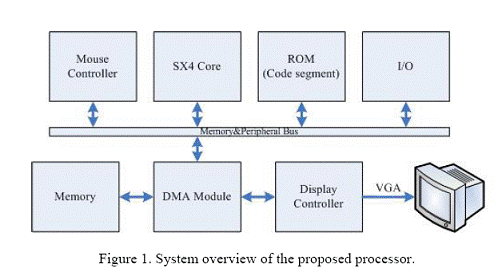
<fig 4 SX4 computer>
Here is a more recent work, a 32-bit computer system. The
processor is very small (10,000 gates) and works quite well
(performance comparable to Xilinx stock softcore). The
chip has integrate graphic controller (it is quite ahead of Intel,
hey!). The main point is, it is cheap (because we steal an FPGA board
from the lab!). Pong (C. Satayavibul) demonstrated the system
running a game of Life complete with a working mouse in 2007. (now he
is working in a bigname company).
Well, finally here is the publication list (for undergrad. students,
just ignore it!)
last
update
28 Nov 2010